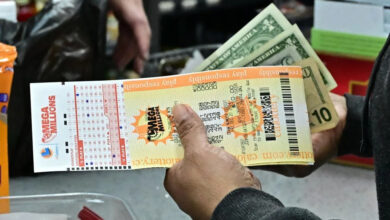
The Powerball jackpot is nearly $1 billion again. Here’s why I don’t want to win
The Powerball jackpot is once again approaching that eye-popping billion-dollar threshold.
After no ticket matched all six numbers in Saturday night’s drawing, the jackpot has climbed to an estimated $905 million ahead of Monday night’s drawing. A winner could choose the full prize paid as an annuity over 30 years or take the lump-sum cash option of $391.9 million before taxes, according to Powerball.
Even after federal taxes take a massive bite, we’re still talking about the kind of money that can completely rewrite a person’s life overnight. And, as a California resident, I’d have one particular advantage: The state doesn’t tax lottery winnings.
Just wow. A $905 million Powerball jackpot is the kind of headline that makes even the most rational among us pause for a major daydream sesh. Of course, it’s fun to imagine the possibilities. For starters, I live in a notoriously high-cost-of-living city, and yes, I’d love to upgrade from our current setup to a three-bedroom house so my teetering-on-puberty boy-girl twins could each have their own rooms. For that reason alone, would I suddenly love to come upon a huge chunk of change? Like most people, I’d obviously say yes to the windfall.
But here’s where I apparently differ from a lot of people buying tickets ahead of Monday’s drawing: I genuinely wouldn’t want to win $905 million.
History shows that this level of money — the kind attached to a headline-making Powerball jackpot — often comes with risks that can seriously complicate the fantasy. So, truth be told, I’m OK with not beating those roughly 1-in-292-million odds.
Sudden wealth can upend lives — fast
Financial experts and psychologists have long warned about “sudden wealth syndrome,” a term used to describe the anxiety, guilt, paranoia, and identity crises that can follow a massive, unexpected financial windfall. According to wide reporting by outlets including The Washington Post, lottery winners frequently experience fractured relationships, isolation, and a loss of trust as friends, relatives, and even strangers begin treating them differently.
A widely cited 2011 study published in the Journal of Economic Psychology found that lottery winners reported no long-term increase in happiness compared to non-winners. In some cases, they experienced more stress due to financial management pressures and social fallout. TL; DR: more money but less happiness. Or, you might say, mo money mo problems.
Many winners lose all the money and more
The cautionary tales are everywhere. Academic research from the National Endowment for Financial Education has found that a large percentage of people who receive sudden wealth — including lottery winners — exhaust or lose it within a few years, often due to poor financial planning, fraud, or pressure from others.
Investigations have documented former jackpot winners who ended up bankrupt, estranged from family, or facing legal trouble after being targeted by lawsuits and predatory “investment opportunities.” It’s not just bad budgeting — it’s the psychological whiplash of going from normal life to extraordinary wealth overnight, without guardrails.
The loss of privacy is real (and forever)
In most states, lottery winners’ names become public record. That means media attention, unsolicited contact, and an immediate erosion of anonymity. Winners often report needing security upgrades, legal teams, and even relocation just to feel safe.
I don’t want to wonder whether the person whose eyes linger on me too long knows my net worth. I don’t want my kids’ privacy compromised because of a random number pulled from a machine.
Money can solve problems — and creates new ones
Of course, some amount of money can and does absolutely alleviate stress for many people. It can buy healthcare, housing security, and opportunities. But research from Princeton University famously found that emotional well-being plateaus after a certain income level — far below billion-dollar territory.
Past that point, more money doesn’t equal more peace. Sometimes, it just means bigger problems with higher stakes.
If I could wave a wand and add comforts to my life, plus the ability to contribute huge sums to causes I care about without detonating everything familiar and safe — sign me up. (And I do love gambling.) But history suggests that winning a jackpot this enormous will not be an actual blessing for most people.
If I could wave a wand and add comforts to my life, plus the ability to contribute huge sums to causes I care about without detonating everything familiar and safe — sign me up. (And I do love gambling.)
But $905 million isn’t a sum anyone needs.
So will I fantasize about what I’d do with it? Absolutely. Would I take a few million bucks without complaint? Please and thank you.
But when it comes to Monday night’s jackpot, I think I’m genuinely OK with my certain fate: not winning it.
Want more stories like this? Follow me for relatable takes on travel, lifestyle, and pop culture.
This content is sourced from creators.yahoo.com and is shared for informational purposes only.