Manager says he followed Circle K policy to buy $12.8M lotto ticket
Gregory Clifford/Getty Images
Since February, controversy has reigned over who rightfully owns a $12.8 million Arizona Lottery ticket printed at a Circle K in north Phoenix. Now one of the claimants — Robert Gawlitza, an ex-Circle K manager who clocked out to buy the winning ticket the morning after the drawing — is asserting his ownership in court while saying the store fired him for claiming the ticket was his.
Earlier this year, Circle K filed a lawsuit in Maricopa County Superior Court, asking a judge to determine the correct owner of the “The Pick” ticket that won the Nov. 24 drawing. Circle K has not officially staked a claim, though it confiscated the ticket from Gawlitza. Since the lawsuit began, several others with potential claims to the ticket have been identified, including Gawlitza, another Circle K employee and one customer.
What happened with the winning ticket is not really in dispute. Multiple parties to the lawsuit agree that a customer — who asked Phoenix New Times to refer to her as Anna Kim — entered the store on Nov. 24 and asked for $85 worth of tickets for The Pick. However, the customer paid for only $60 worth of tickets. The remaining tickets fell out of sight and were later discovered by an employee. That night, one of those tickets hit the jackpot.
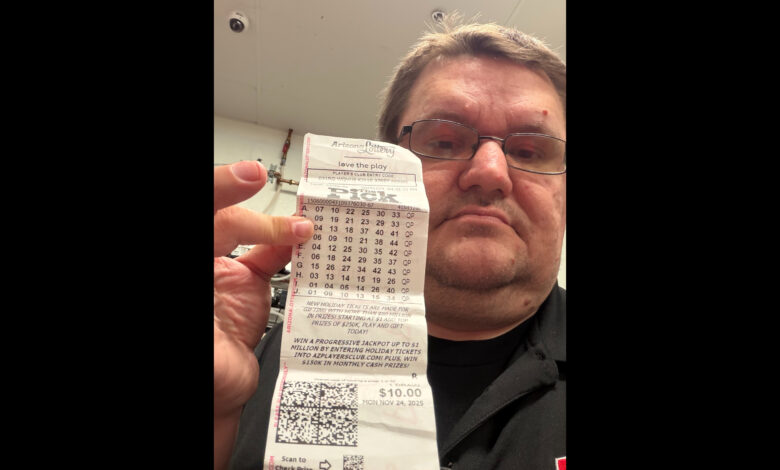
Lottery rules state that printed but unpaid tickets constitute legal wagers, since vendors pay the lottery for each printed ticket. The next morning, Gawlitza realized the winning ticket was in his store. To avoid running afoul of lottery regulations that bar vendors from buying tickets while on the clock, Gawlitza clocked out and changed out of uniform before “buying” the ticket from a store employee for $10. He signed the back of the ticket to claim his prize, though Circle K later took it from him.
What is in dispute is whether any of that is allowed. Though Circle K’s filings have cast a suspicious light on Gawlitza’s shenanigans, Gawlitza claimed in a new legal filing that he was merely following long-established store protocol. Included in his filing are text messages with a Circle K district manager in which Gawlitza got the green light to pull the exact same maneuver he used to buy the winning ticket.
“Circle K required employees to purchase accidentally generated unsold lottery tickets with personal funds,” the lawsuit reads, adding that Circle K “treated purchased tickets and any winnings as the property of the purchasing employee.”
Gawlitza’s attorney, Joshua Kolsrud, declined to answer questions from New Times. Representatives for Circle K did not respond to an email with questions about the case.
Gawlitza’s filing says Circle K “maintained an established, consistent and well-known policy and practice” that required employees “to purchase, with their own personal funds and at full retail price, accidentally generated unsold lottery tickets whenever the total value of those tickets was $20 or more.” That policy “required the purchase to occur the morning after the applicable drawing and required the employee to purchase the most expensive ticket first.” Per the filing, Circle K did not reimburse employees for those purchases, and any winnings from them belonged to the employee who purchased the winning tickets.
Although the lawsuit admits the policy was unwritten, Gawlitza’s filing includes six affidavits from current or former Circle K employees testifying to its existence. One Circle K employee wrote in her affidavit that she won $9 by buying a ticket under that policy, and that Circle K did not claim the winnings. A former Circle K manager wrote in his affidavit that he once bought $110 worth of unsold tickets to prevent other employees from being written up for violating the policy.
“The Policy required an employee to purchase enough of the Additional Tickets, beginning with the most expensive ticket, at full retail price and with personal funds, to bring their remaining value below $20,” Gawlitza’s filing reads. Gawlitza claims that by buying the winning ticket for $10 — though it’s unclear whether that was the ticket’s face value — he fulfilled that requirement.
Gregory Clifford/Getty Images
Texts with the boss
Additionally, text messages included in the filing purport to show that Gawlitza made his bosses quite aware of what he was doing. One exchange with district manager Dawn Crosby, whom the filing identifies as Gawlitza’s direct supervisor, shows Gawlitza addressing the subject head-on.
“Question boss,” one message from Gawlitza to Crosby reads, “if I clock out of work, take off my work shirt and buy a lottery ticket. Then after purchase clock back in. Is the (sic) acceptable by the company?” With the message, he included a screenshot of a news story showing that the winning ticket had been printed at his store.
“Yes,” Crosby replied.
“I asked because the winning ticket was sitting in my store for the 12.8 million winner and that is what I just did,” Gawlitza responded. He went on to say he had plans to split the winnings with two others — only one other, Circle K employee Marline Ybarra, is currently pressing a claim alongside Gawlitza — before reassuring Crosby that “we ain’t quitting the store or you. We just are not broke anymore.”
In response, Crosby joked that “I’m not rich either” before telling Gawlitza that she had to run the question up the ladder because “we’ve never run into this before.” She added: “BTW, if I get this approved I have a min. 2 million service charge.” Gawlitza responded that “you will get a slice boss for sure for the assist.”
Circle K apparently was not happy, though. Not only did it confiscate the winning ticket, but it also fired Gawlitza on Jan. 31, just weeks before it filed suit to determine the ticket’s rightful owner. Per Gawlitza’s filing, the company terminated him because “he had violated store policy by purchasing the Ticket because, in Circle K’s view, he was still working when he did so.”
The next day, Gawlitza texted Crosby again to confirm that he had done nothing wrong. Among a series of questions sent to Crosby, Gawlitza asked, “Can a store manager clock out of his shift, wait an hour on the property and clock in after the hour to do his second shift for the day because the store requires it?”
“Yes to all,” Crosby replied.
“Well that is what I did,” Gawlitza responded. “So I purchased my ticket after shift 1 and before shift 2. Which it states is acceptable in the employee hand book. Then 2 minutes later clocked in for shift 2, which would there for (sic) mean I followed the rules they presented to their employees and my termination is there for (sic) not allowed.”
“I agree,” Crosby replied.
Though he and other current and former Circle K employees say that company policy required them to purchase unsold tickets the next morning, they do not claim that the company required them to clock out and change out of uniform to do so in that specific circumstance. If they did not have to clock out and change to purchase unsold tickets, it raises the question of why Gawlitza felt it necessary to do so. If such technicalities were required for what Gawlitza claims to be a routine event of purchasing unsold tickets, it’s not clear why Gawlitza would need to confirm the policy with a supervisor.
Though Circle K is not pressing a claim against Gawlitza — it is only asking the court to declare a rightful owner — Gawlitza is countersuing his former employer on six counts, including breach of contract, breach of the covenant of good faith and fair dealing and tortious interference with prospective economic advantage. He and Ybarra are asking the court to declare the ticket is theirs and to prevent Circle K from pressing its own claim, and to force Circle K to return the ticket. Amusingly, given the size of the jackpot, they’re also asking for financial damages and attorney’s fees.
No hearings are pending in the case.
This content is sourced from www.phoenixnewtimes.com and is shared for informational purposes only.