A Nobel Prize-winning author admitted she uses AI. What’s the literary world coming to? – The Boston Globe
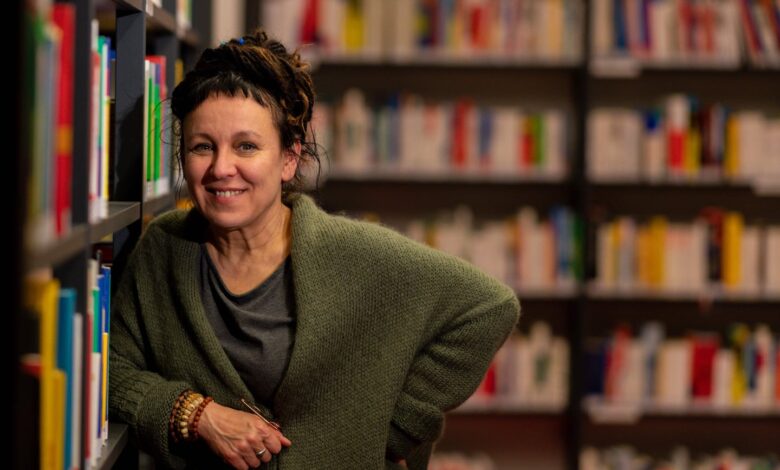
Of her use of chatbots in writing, the Nobel laureate described her process in affectionate terms. “I often throw an idea to the machine for analysis, asking, ‘Honey, how could we develop this beautifully?’ Even though I know about the hallucinations and numerous errors of factual algorithms in the fields of strict economics and hard data, I must admit that in fluid literary fiction, this technology is an asset of incredible proportions,” she said. “I purchased the highest, most advanced version of one language model, and I’m often deeply shocked by how fantastically it broadens my horizons and deepens my creative thinking.”
In a statement shared by her US publisher, Riverhead Books, Tokarczuk disputed the details in the Polish article, saying that “remarks made before a live audience at a public event can be incorrectly understood,” and that she did not write her forthcoming book “using AI or with anyone else.” Tokarczuk said that she only uses AI tools for “preliminary research,” adding, “I make use of artificial intelligence on the same principles as most people in the world — I treat it as a tool that allows faster documenting and checking of facts. Whenever I use this tool, I additionally verify the information. Just as I have done for several decades by reading books and by exploring libraries and archives.”
Amid the rise of generative AI programs, previously held assumptions about reading, researching, writing, and editing seem increasingly up for reassessment. And readers, who come to literature seeking human connection across distance, time, and languages, are left in a confusing state: Why am I reading a book that a human being couldn’t be bothered to write?
There’s the distinguished literary magazine Granta, first published in 1889 by bookish types at Cambridge University. Renowned more recently for its annual lists of best young novelists (British and American editions), Granta has remained remarkably hardy in the topsy-turvy, financially precarious world of serious literary journals. News came this week that it, too, had published a piece likely composed using an AI tool.
According to Brittany Allen, writing in Literary Hub, Granta’s recently published “The Serpent in the Grove,” a short story by Jamir Nazir, in partnership with the Commonwealth Foundation Short Story Prize, has been identified as likely composed by an AI tool. Nazir, who is 61 and Trinidadian, has a self-published poetry collection and a collection of inspirational quotes to his name, and, notes Allen, “is a frequent AI evangelist,” at least on his LinkedIn profile. The accusation comes, with a whiff of irony, from Wharton Professor Ethan Mollick, who has both warned about AI and sung its praises; after Mollick brought attention to the story, readers, editors, and writers on BlueSky have pointed out the story’s over-the-top, often mangled use of metaphor.
Granta has added a statement above the story on its site, but says that until the AI accusations are proven, the story will remain.
And news broke this week that “The Future of Truth: How AI Reshapes Reality,” a book by Steven Rosenbaum that came out earlier this month, was in fact shaped by AI itself. According to an article by Benjamin Mullin for the Times, the book “incorporated more than a half-dozen misattributed or fake quotes,” an oversight first noticed by the paper’s staff this week. Rosenbaum released a statement Monday night saying that he was conducting his own investigation into the “handful of improperly attributed or synthetic quotes,” presumably the product of AI tools’ notorious propensity for “hallucinating.”
Among the writers who found themselves reading new-to-them quotations above their names were frequent tech writers Kara Swisher and Meredith Broussard, as well as local academics Lisa Feldman Barrett and Lee McIntyre.
Rosenbaum’s statement described the situation as “a warning about the risks of AI-assisted research and verification,” and argued that the errors “do not, in fact, diminish the larger questions that the book raises about truth, trust, and AI …”
Fair enough. The larger questions about authorship, readership, and what it means to be human remain at the top of many minds, including Tokarczuk’s.
Despite her own use of AI and her friendly feelings for the app, Tokarczuk does admit that something is lost in adopting non-human authorial aides.
“At the same time, I feel a piercing, very human sorrow for an era that is disappearing forever. My heart aches for the passing of traditional literature, written over months in solitude, a work of life crafted in the mind of a fully conscious, single individual.”
Kate Tuttle edits the Globe’s Books section. You can reach her at kate.tuttle@globe.com
This content is sourced from www.bostonglobe.com and is shared for informational purposes only.