Can picking personal Lotto lines change the odds of winning? We ran the numbers
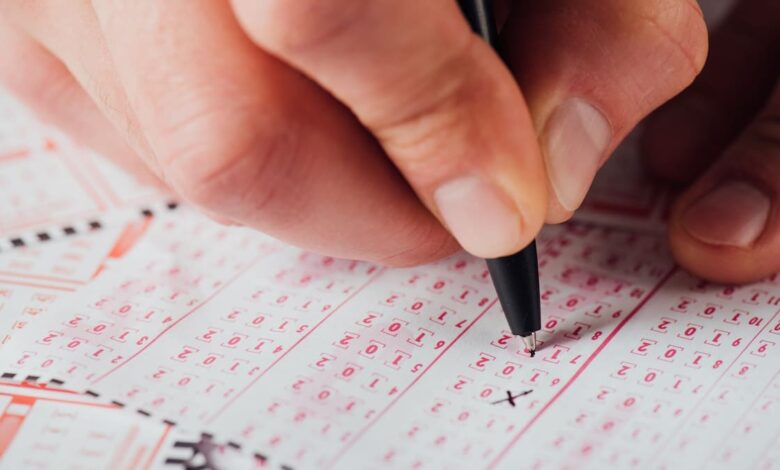
The most favoured six-tuples include straight lines, diagonals and other geometric patterns on the Lotto playslip. Another popular choice is skip-counting sequences starting at low to middling numbers and based on steps of between one and nine.
Players also love to pick winning numbers from TV shows such as The Simpsons and Lost, famous mathematical patterns such as the Fibonacci sequence and previous winning six-tuples.
As well, players have a mild tendency to avoid the edges of the payslip and to cluster numbers on the payslip within each six-tuple, just as they might position ships in the boardgame Battleships.
Do some tickets win more often?
Can any combination of six-tuples on a ticket influence the probability of a win? Most certainly.
Think of a six-tuple as tracing out a path on a payslip, like a Tube line on a map of the London Underground rail system.
Suppose a ticket’s six-tuple paths, when superimposed upon each other, spread out like Tube lines in the outer reaches of the map, with little overlap. Then they cover more numbers than a typical Lucky Dip. That, in turn, slightly increases the ticket’s probability of winning a prize.
Conversely, six-tuple paths that overlap heavily, as with the centre of the map, can dramatically reduce a ticket’s overall probability of winning a prize. An extreme case is playing only identical six-tuples on the same ticket.
There are, however, natural trade-offs: tickets designed to win prizes more often than a Lucky Dip typically pay less than one when they do win. On the other hand, tickets designed to win less often than a Lucky Dip can pay dramatically more than one when they win.
When more can mean less
We also found New Zealand Lotto players think surprisingly alike. Some six-tuples are chosen by so many players that if they were to win the first-division prize, it would be split dozens – or even hundreds – of ways.
In such cases, self-selected numbers can become remarkably costly.
For example, if any of the 40 most popular six-tuples wins the $1 million first-division prize, we estimate each winner’s share will likely be no more than about $5000. For the two most popular six-tuples – 5, 10, 15, 20, 25, 30 and 1, 2, 3, 4, 5, 6 – it could mean less than $1000 each.
The odd-number sequence 3, 5, 7, 9, 11, 13 famously produced 40 first-division winners in New Zealand in 2018. However, it is so popular now – ranked 99th among all chosen six-tuples – that if that same sequence won the first-division prize today, it would be shared by twice as many people as in 2018.
The irony is that many people choose popular six-tuples because some underlying attribute makes them appealing. Yet it is precisely their wide appeal that reduces their value.
Is a Lucky Dip the best bet?
This is where Lucky Dips can compete favourably with self-selected numbers.
Lucky Dips are randomly generated. As such, they are far less likely to produce the obvious patterns and popular six-tuples favoured by human players, reducing the risk of excessive prize sharing.
Indeed, our analysis suggests that by avoiding popular patterns, the average randomly-generated ticket has a higher expected payoff than the average self-selected ticket.
But a player who wants random numbers should let the computer choose them, because human brains are remarkably poor random number generators.
Lucky Dips are no longer required, however, to avoid popular six-tuples.
Our research identifies the 40 most popular six-tuples and includes a searchable spreadsheet listing the 5000 most common combinations. Players can now check whether their lucky numbers appear on the lists – or whether they really are as original as they think.
And although we use New Zealand Lotto data, most of our methods and results apply to other lotteries globally.
The bottom line
Lotto should be thought of as a form of entertainment, not an investment. There is nothing wrong with choosing numbers that have personal meaning.
Ultimately, however, the most common choices increase the likelihood of sharing any prize that might eventually be won. Those seemingly lucky numbers that feel special to us often feel special to hundreds of other people as well.
Although some players spend years refining systems to gain an edge, there is no complex secret system for beating Lotto.
In fact, two of our main takeaways are quite simple. Self-selected number choices can influence the probability of a win – but with natural economic trade-offs. And players can reduce prize-sharing risks by avoiding popular six-tuples – whether they use a Lucky Dip or not.
The draw might be random. But how players pick their numbers can still make a surprising difference to the odds of winning and what happens if they win.
Sign up to Herald Premium Editor’s Picks, delivered straight to your inbox every Friday. Editor-in-Chief Murray Kirkness picks the week’s best features, interviews and investigations. Sign up for Herald Premium here.
This content is sourced from www.nzherald.co.nz and is shared for informational purposes only.