Commentary: Should the state be in the fantasy-selling business?
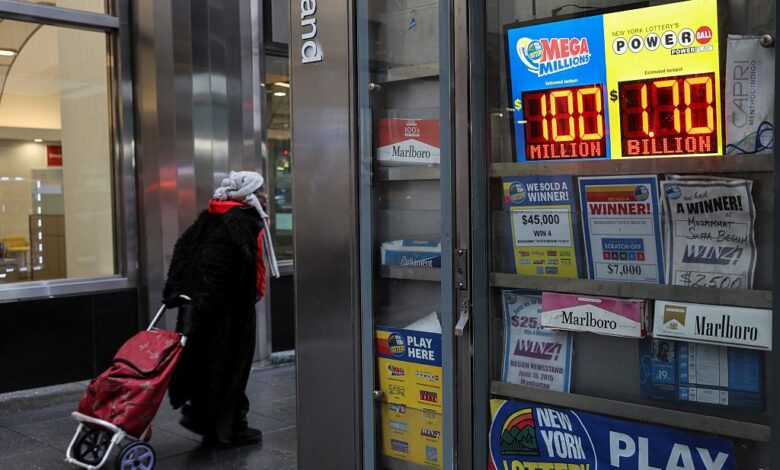
Powerball and Mega Millions numbers are displayed at a newsstand in New York City on Dec. 23, 2025.
“Can you imagine?” That simple question has been adopted as a slogan by the New York Lottery. The current crop of television commercials trumpets the life-changing joys that are one simple lottery win away.
One young woman would learn Mandarin, hang glide and skydive! Another lucky pair would travel to Fiji, by private jet! Naturally, all of this is expressed in a breathless, excited voice, only interrupted by the clerk who asks, “So, you gonna play or what?”
An on-screen graphic exhorts all to “PLAY TODAY!” — because to get you to buy a ticket is what the New York Lottery is most interested in.
This is not to debate the propriety of New York or any other state running a lottery. That ship has sailed. But it is to question the appropriateness of a government agency engaging in an emotionally seductive promotion of a habit that can lead to a crippling addiction that destroys families, finances and, in the worst cases, actual lives.
It is one thing for private, for-profit companies to engage in this kind of promotion. But governments should be held to a higher standard. For the state to use the time-tested, manipulative tools of advertising to hide the ugly reality of gambling behind a facade of fun and fulfillment is crossing the line.
When a government entity itself floats the false narrative that gambling could lead to all one’s hopes and dreams being fulfilled, it conjures up the advertising days of the past, when the pleasures of smoking filled the airwaves and the ruggedly handsome, virile — and certainly healthy — Marlboro Man reminded us all that cigarettes were as American as apple pie. As our knowledge of the dangers of smoking increased, the government stepped in to ban this kind of advertising.
State-sponsored lotteries are set up to raise revenue for governments. They are, in effect, a tax on the segment of the population who voluntarily contributes to the pool. Studies show that lower-income individuals disproportionately spend a larger percentage of their income on the very unlikely chance of hitting it big.
To add insult to injury, should someone win, the government will double-dip because there is a mandatory tax on your winnings. New York state will take about 10% of a big win. This can rise up to roughly 14% if you live in New York City. Add in the federal grab and nearly 35% of your winnings could go straight back in taxes — on a purchase that was already essentially a tax.
Instead of disingenuously promoting the likelihood of a win using the language of dreams coming true, the state should instead, with full transparency and equal fanfare, reveal the astronomical odds against a win of any life-changing significance.
It’s worth remembering that the lottery does have a predecessor. Before being sanitized by governments, it was called the “numbers racket” and it was run by gangsters. When the mob was in charge, governments sought to shut the rackets down because they were viewed as an exploitive practice that preyed on the least fortunate.
Those are the shoes that are now filled by the New York Lottery. Can you imagine?
Gavin MacFadyen is an attorney and writer in Jamestown, Chautauqua County.
This content is sourced from www.timesunion.com and is shared for informational purposes only.