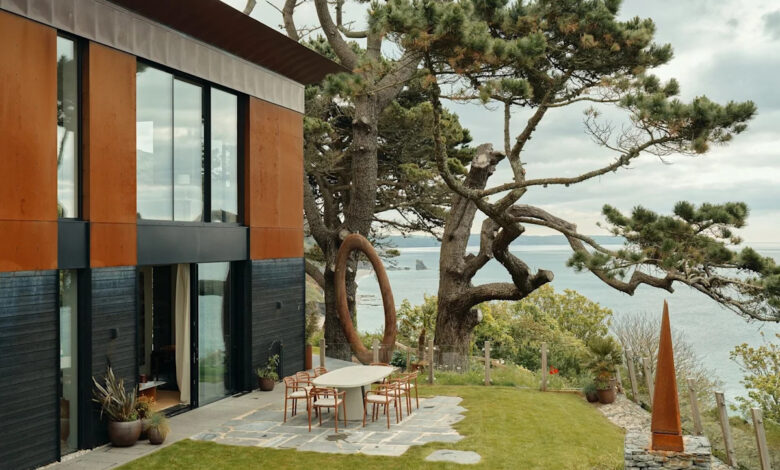
(Bloomberg) — On the outskirts of the village of Downderry on England’s Cornish coast stands the Chicken Shack, a newly built, 3,400-square-foot home with an expansive view of the ocean. With its near floor-to-ceiling windows, elegant mid-20th-century furnishings and Japanese-style wood-fired hot tub, it is, for any number of people, the definition of a dream property.
Most Read from Bloomberg
And the next owner of the £3.5 million ($4.7 million) house will take possession for as little as the price of a stamp. Omaze Inc., a company that has turned raffling off luxury UK houses into a booming business, will announce its winner on Friday.
Joshua Penk, a local architect who spent about three years working on the house with its former owners, said he entered the draw. So had just about everyone else in Downderry who spoke to Bloomberg.
“My house, where I live at the moment, is being condemned,” said Sandra Watchman, a volunteer at the local community-run store. She first heard about the raffle from other people in the village. “It would be great if I could win.”
Omaze has been buying up and raffling off luxury houses around the UK since 2020. In recent years, it has purchased about one a month and generally spends at least £150,000 on furnishings before opening the draw. The Chicken Shack is the 49th British property to pass through its hands.
Omaze is a for-profit company, but it helps drive entries by pledging a portion of ticket sales to charitable partners working in areas like cancer care, Alzheimer’s research and suicide prevention. Last year, it donated more than £50 million, or 21% of its revenue, to charities.
Would-be winners can enter the raffle by sending in a postcard, or improve their chances by purchasing a monthly subscription or a ticket bundle, with prices often starting as low as £10. The properties are worth about £4 million on average and prizewinners also receive £250,000 to help cover expenses, which can be significant on such properties. They are free to move in, rent out or sell on as they choose.
“We are operating at a premium, luxury, dream-come-true level, and we want the dream to be real when it comes true,” said Matt Pohlson, Omaze’s co-founder and chief executive officer, in an interview.
The dream is also working out nicely for Omaze. The Wilmington, Delaware-based company’s UK operations became profitable for the first time in 2024 and in May reported that net income before tax more than doubled last year to £12.8 million. Revenue from ticket sales jumped 22% to about £240 million.
Now, Omaze is setting its sights on bigger markets. After expanding into Germany last year, the company is looking to expand by returning to the US “in the next couple of years,” according to Pohlson, 48.
New: Get the Bloomberg Money newsletter — insights, ideas and tools for doing more with your money.
“We think this will work in every market. It is a very fundamental thing, to want a better house,” he said, adding that the company is still considering which parts of the US to start in. The challenge is identifying regions where a house – and its location – will have broad appeal.
“In the UK, the whole country is 97,000 square miles,” about half the size of California, he said. “The population density really helps.”
Public Eye
For the UK’s depressed real estate market, Omaze prize draws have been a buoy.
Demand for country houses surged during the Covid-19 pandemic, but in the years since, the market for homes outside London has tumbled on the back of higher taxes, the elimination of incentives for so-called non-doms and uncertainty about everything from war to elections, according to Tom Bill, head of UK residential research at Knight Frank.
“Transactions are good whether Omaze is buying or their winners are selling,” said Harry Gladwin, who oversees purchases in the sought-after Cotswolds region at high-end broker The Buying Solution. “It’s all helpful and keeps the market turning over, keeps this area in the public eye.”
In the year through January 2026, 177 country homes were bought for £4 million or more, according to Knight Frank research — a drop in volume of 42% from the market’s recent peak, four years earlier. Based on those figures, Omaze houses account for about 6% of the market.
Omaze “decide what they want and they will pay what they need to secure it,” said Claire Carter, who, as head of country houses for UK broker John D Wood & Co., has had clients go up against Omaze in bidding wars. In her view, some buyers are “probably not happy,” but sellers are “probably rubbing their hands together and thinking, ‘We love these guys.'”
Twenty-four of the UK properties bought by Omaze since 2020 were resold, or are currently for sale, at a lower price than the company paid, according to data compiled by Bloomberg from land records, the Move Market property platform and news reports.
Omaze uses an independent surveyor to value its properties for the draws rather than advertising them at the price it paid. Bloomberg found that, on average, winners have sold their UK houses for £286,000 less than the advertised value. Four properties have sold for more, including a Cotswolds house sold for more than £900,000 over the advertised value.
Whether Omaze is potentially overpaying doesn’t seem to faze Pohlson. The company “isn’t about optimizing real estate,” he said.
Meanwhile, raffle winners are likely to be less concerned about maximizing value than most sellers, The Buying Solution’s Gladwin said. “They’ve just had a windfall, they want their money out.”
He monitors the draws in the Cotswolds “because my expectation is that that property is then going to be sold six or 12 months later.”
Not every Omaze story runs smoothly. While winners are all walking away with a prize valued in the millions, a handful have reportedly said they found the financial burden of maintaining their new property unmanageable, while others have faced logistical hurdles like planning permission.
Oli Goss, a spokesman for Omaze, refuted reports that some winners sold up because of costs, saying that the cash given away with each house should comfortably cover years of expenses. He said Omaze is happy to see winners sell up and cash in and is proud to have minted more than 50 millionaires and raised over £100 million for charity.
Chris Milnes from Pudsey, Yorkshire, won a 4,200-square-foot, five-bedroom house in Dorset in June 2024 for which Omaze had paid about £2.5 million a few months prior. Milnes resold it for less than half that — £1.2 million — last year, according to public records.
“It’s impossible to make a loss on a house I didn’t buy,” he wrote in a message, adding that “Omaze changed my life beyond my wildest dreams.” He wrote that he used the proceeds from the sale to buy a luxury five-bedroom house closer to home.
Fierce Competition
Pohlson, Omaze’s California-born CEO, started the company in 2012 with co-founder Ryan Cummins (who left the company in 2018). At first, its prize draws were for experiences, such as a ride in a tank with Arnold Schwarzenegger, before graduating to cars then real estate, with a handful of properties in Austin, Los Angeles and Lake Tahoe.
Investors include Jeffrey Katzenberg’s WndrCo, former Boston Celtics owner Wyc Grousbeck and Reddit co-founder Alexis Ohanian.
The scrutiny and skepticism has been plentiful.
California’s attorney general opened an inquiry into Omaze’s sweepstakes practices that was settled in 2020 with no admission of fault, and an agreement that the company would pay $90,000 in reimbursements and $30,000 in fees and penalties for operating without properly registering as a commercial fundraiser for charitable purposes. A class-action lawsuit that accused the company of violating lottery statutes by purporting to fundraise for charities but taking the majority of revenue for itself was dismissed in 2022.
In 2023, Omaze paused its US operations to focus on the UK. The issues weren’t behind the decision to pivot to the UK, said Pohlson. The company couldn’t afford to pursue house giveaways in both markets, so it focused on the smaller market where luxury homes are less expensive, he said.
In a country where real estate is a national obsession, the concept struck a chord.
Even as the overall UK market has softened over the past three years, the competition for the relatively rare house that fits the Omaze bill can be fierce, according to Anoushka Millard, Omaze’s property head.
Houses in Cornwall must have a sea vista, ideally framed by vast windows. Period properties do well in the Cotswolds or the historic city of Bath. Northwest England’s famously beautiful Lake District is very desirable — as long as there’s a view of the water. Omaze now has a revolving credit line that allows the company more time to buy, build or redevelop the right house.
In London, it is harder to find houses with a “wow” factor within Omaze’s price range, although Millard says the company aims to offer more homes in the capital soon.
Some properties aren’t on the market when Omaze finds them. The Chicken Shack’s previous owners, Andrew and Fran Fernbach, had built the place for themselves after living for almost 20 years in a late-19th-century house on the same stretch of land, according to Penk, their architect. He said they had recently moved into the new build and hoped to sell the older house to help offset the costs. Instead, they had an unexpected buyer for their brand new abode. The couple didn’t provide a comment.
Almost everyone is tight-lipped about the process — Omaze asks sellers, brokers, builders and others to sign non-disclosure agreements. In Downderry, a man who had worked on the Chicken Shack ran away when approached by Bloomberg, saying he wasn’t allowed to talk.
“Given the high-profile nature of the business and its prize draws, a degree of confidentiality around property locations and commercial relationships is reasonable and to be expected,” Omaze said in a statement.
Several Downderry locals said they were flooded with ads for the Chicken Shack raffle. Sipping a beer at a village pub, 65-year-old Nolan Jones had his doubts. He said he didn’t trust big corporations or the moneyed outsiders who might potentially end up buying the house.
“I know a few locals who would really like to live there,” he said. Of the potential winner, he added, “I hope it’s a friend.”
–With assistance from Meg Short and Jack Sidders.
Most Read from Bloomberg Businessweek
©2026 Bloomberg L.P.