🌍 The Cold Barrier Is Breaking: Mosquitoes Are Moving North
Once restricted to tropical and subtropical zones, mosquitoes are now thriving in new, colder regions — including Iceland, a place previously considered mosquito-free.
This shift signals a profound ecological change: climate warming is eliminating nature’s disease defense line.
As temperatures rise and winters soften, Aedes, Anopheles, and Culex mosquitoes — notorious transmitters of deadly diseases — gain access to new habitats and fresh hosts.
Public health implication: Places that never worried about Dengue, Zika, or Malaria must now prepare surveillance systems and rapid-response health plans.
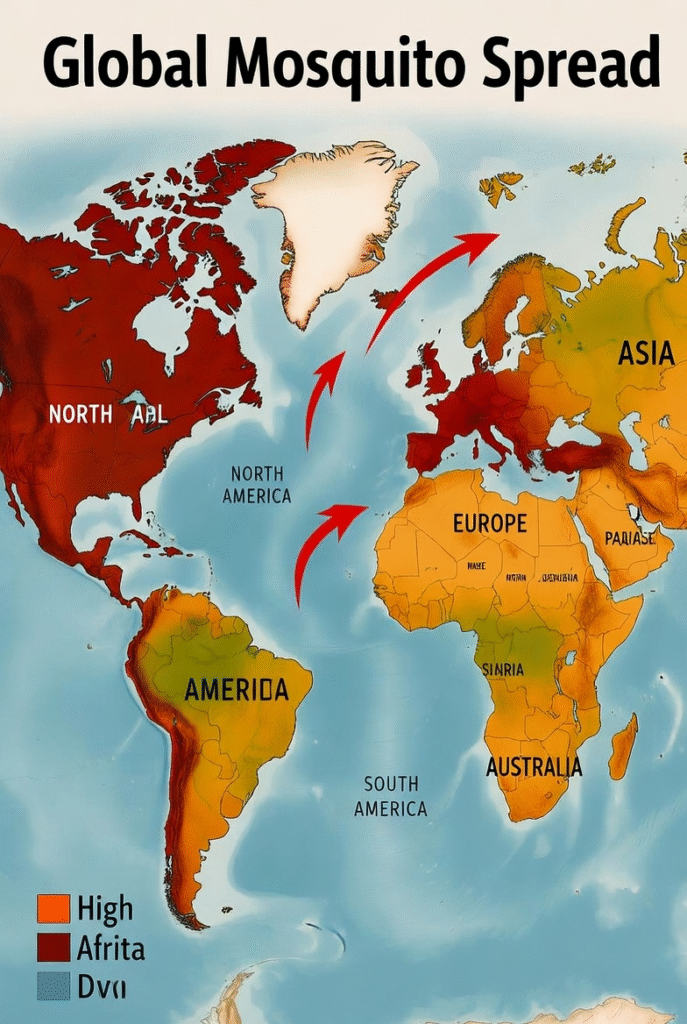
North America, and the Arctic, with red arrows indicating climate-driven expansion.
🦟 Why This Expansion Matters
Mosquitoes aren’t just annoying — they are the world’s deadliest animals, responsible for ~700,000+ deaths annually. Their invasion into cold climates breaks centuries-old geographic immunity.
How they suddenly survive cold?
- Warmer winters
- Climate-driven rainfall changes
- Urban heating (heat islands)
- Evolution of cold-resistant eggs
- Adaptive sheltering behavior (e.g., basements, garages)
Species like Aedes albopictus (Asian Tiger Mosquito) can pause development (diapause), making them biologically prepared to conquer mild winters.
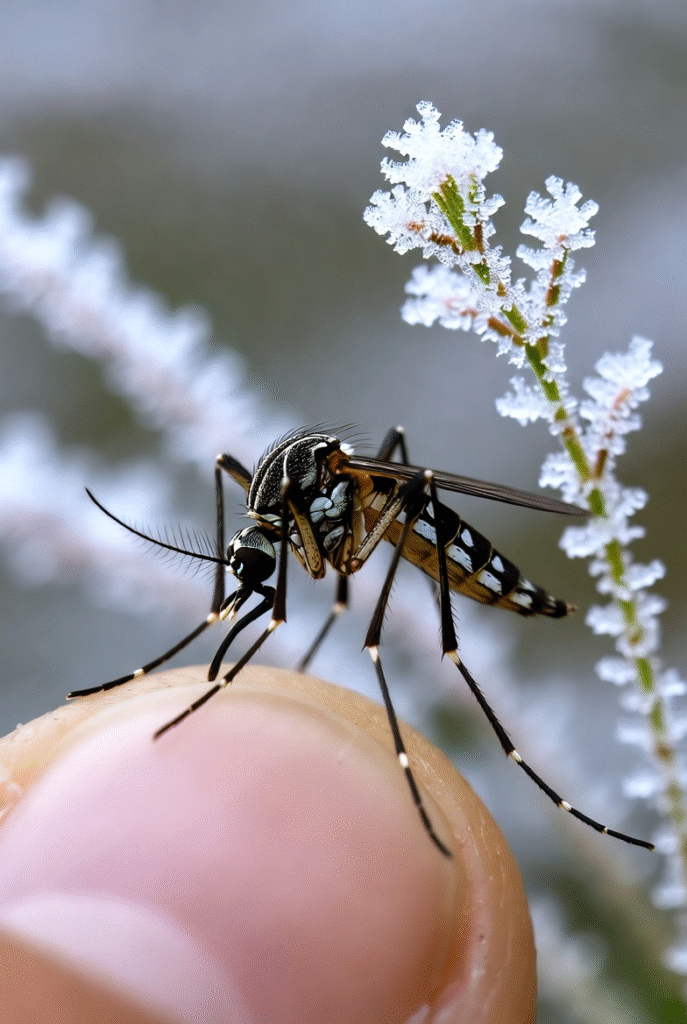
and winter frost surrounding the environment, blending tropics and icy scenery.
🦠 Major Diseases Poised to Spread Further
✅ 1. Dengue Fever
- Vector: Aedes aegypti, Aedes albopictus
- Old Barrier: Virus maturation halted in cold (<18–22°C)
- New Reality: Warmer months enable faster viral replication → longer transmission seasons
Emerging zones: Southern Europe, USA Gulf Coast, East Asia highlands.
✅ 2. Chikungunya
- Vector: Aedes species
- Key Factor: Cold-resistant eggs → rapid European foothold
- Alarming Evidence: Local outbreaks in France and Italy
Populations with zero immunity = explosive outbreaks possible
✅ 3. Zika Virus
- Vector: Aedes mosquitoes
- Risk Factor: Travelers importing infections into areas where Aedes are now established (Europe, US)
Silent threat — low circulation now, but high future potential.
✅ 4. Malaria
- Vector: Anopheles mosquitoes
- Old Barrier: Parasite stops growing under ~16°C
- New Risk: High-altitude Africa, South America, Asia warming by 2–3°C → malaria returns where eradicated
Mosquitoes + parasite + warm nights = malaria revival risk
✅ 5. West Nile Virus
- Vector: Culex mosquitoes
Already present in temperate zones, but rising winter survival = longer seasons + more infections
🚨 Additional Threat: Eastern Equine Encephalitis (EEE)
Rare but deadly, boosted by warm wet summers.
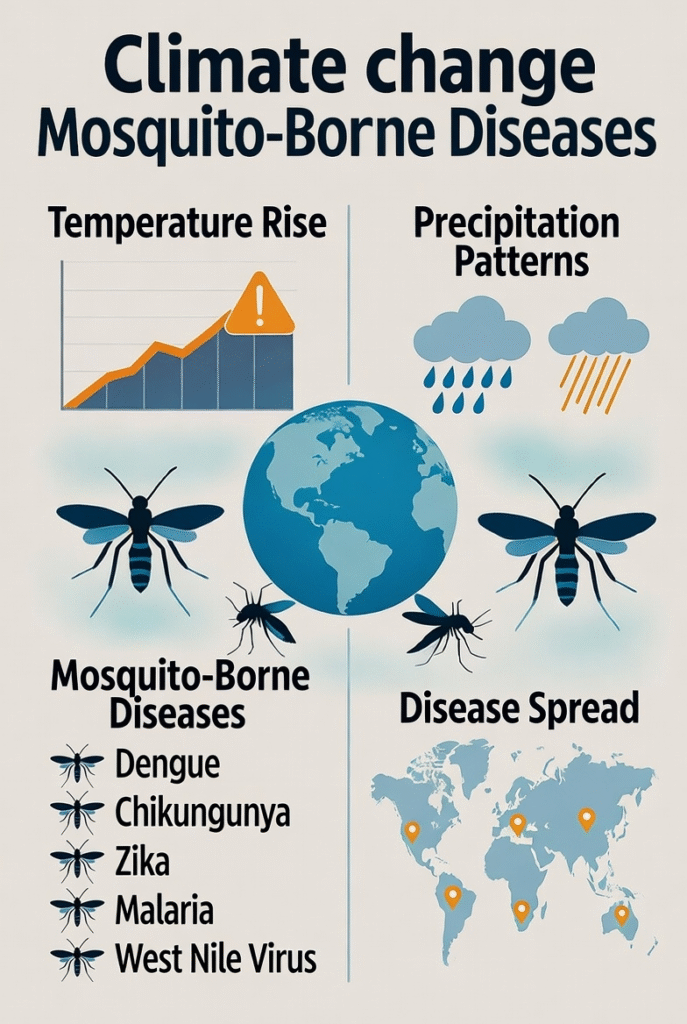
West Nile, with climate change icons, temperature graphs, and globe.
🧬 Climate Change + Mosquito Evolution = Perfect Storm
This is not a simple warming story — it’s ecology + evolutionary biology + urbanization.
Key Drivers
| Driver | Effect |
|---|---|
| Rising minimum temperatures | Overwinter survival & faster viral growth |
| Urban heat islands | High-latitude cities now mosquito-friendly |
| Global travel | Virus introductions into new lands |
| Dormant eggs & cold tolerance | Accelerated northern expansion |
| Behavioral shifts (basements, drains) | Winter survival in homes/buildings |
➡️ Mosquitoes adapt faster than humans prepare.
🛑 Why This Matters for Public Health
Countries like Iceland, the UK, Canada, and Northern Europe now face risks previously limited to tropical regions.
Urgent Public Health Needs
- Mosquito monitoring programs
- Community awareness campaigns
- Rapid traveler screening
- Urban drainage + standing-water elimination
- Climate-health integration in policy
Modern outbreaks often start with one traveler and bloom quietly.
Aedes doesn’t need jungles. It thrives in yards, tires, flowerpots, and drains.
🔮 What the Future Holds
Experts predict:
- 1–2 billion more people exposed to mosquito-borne diseases by 2050
- Tropical diseases in Rome, Paris, Toronto, Tokyo, Seoul
- Highlands like Ethiopia, Colombia, Nepal turning malaria-susceptible
- Earlier spring mosquito seasons, later winter freezes
Climate-disease models already warn:
Health systems in cold countries must think like tropics.
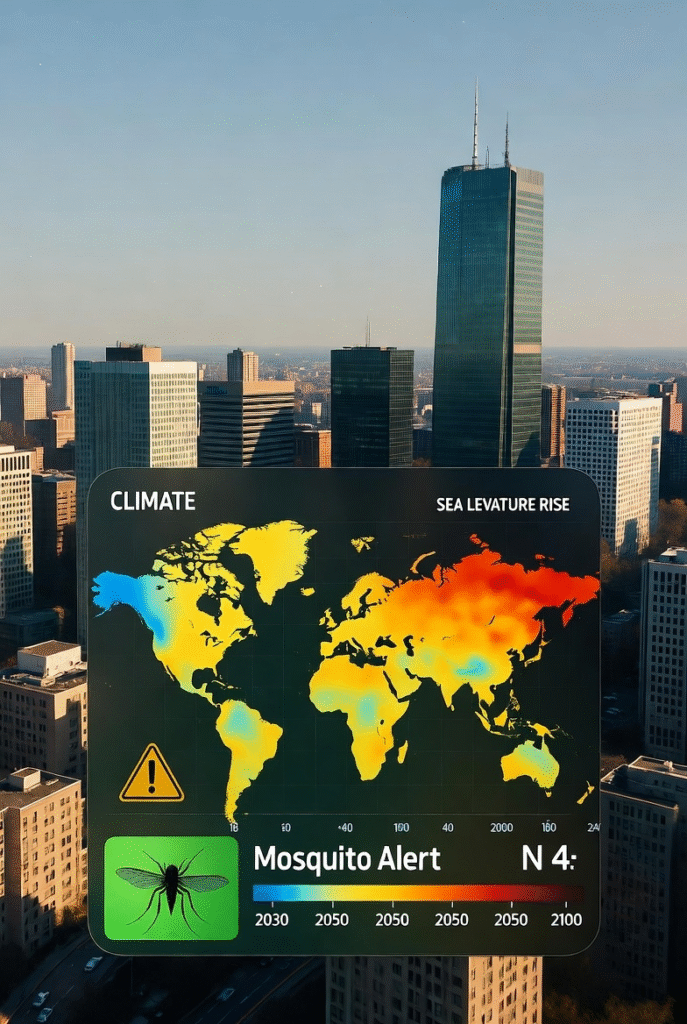
✅ Conclusion
Mosquitoes in frozen places are not a curiosity — they signal a new global health era.
Warmer climates + mosquito evolution are removing disease boundaries once thought permanent.
Nations must:
- Strengthen surveillance
- Prepare healthcare systems
- Educate communities
- Treat climate change as a public health emergency
In the future, geography will no longer protect us — only preparedness will.