Introduction: Why LNB Frequency Matters
If you enjoy satellite television, you have probably noticed a small device sitting on the arm of your dish. That little gadget is called an LNB, short for Low Noise Block downconverter. Without it, your satellite dish cannot deliver a single channel to your TV.
The most important part of an LNB is its LNB-frequency, which decides how satellite signals are received, processed, and sent to your set-top box. Many satellite viewers hear about frequencies such as 5150 MHz, 9750 MHz, and 10600 MHz, but very few actually understand what they mean.
This guide will explain everything about LNB-frequency, the different types of LNBs, their uses, and how they affect the quality of your satellite TV signals.
What is LNB Frequency?
An LNB frequency is the local oscillator (LO) frequency inside the LNB. Its purpose is to convert high-frequency satellite signals into lower frequencies that can travel through a coaxial cable to your TV receiver.
- Satellite signals come from space in the microwave range (3 GHz to 30 GHz).
- These signals are too high for normal electronics and coaxial cables to handle directly.
- The LNB frequency mixes the incoming satellite signal with its local oscillator to “downconvert” it into a manageable range (950–2150 MHz), which your satellite receiver can easily decode.
In simple terms: The LNB frequency is like a translator that makes satellite signals understandable for your receiver.
Common LNB Frequency Ranges
Different satellites transmit in different bands. To match them, LNBs come with specific local oscillator frequencies.
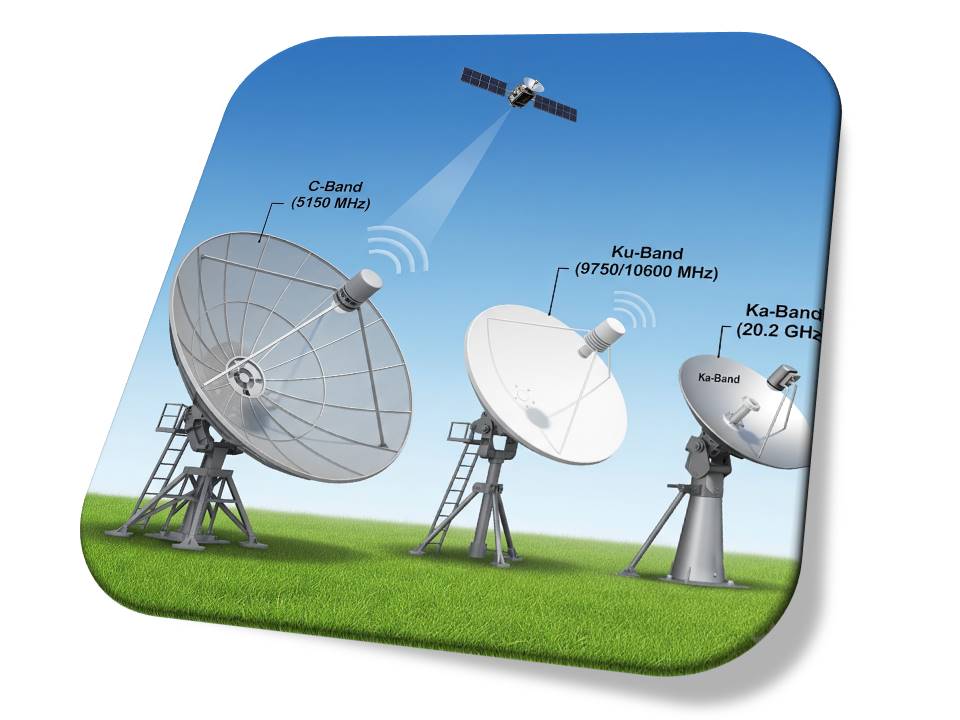
1. C-Band LNB Frequency
- Satellite Signal Range: 3.4 – 4.2 GHz
- LNB Frequency (LO): 5150 MHz (most common)
- Dish Size Required: Large dish (6 to 12 feet)
- Usage: Widely used in Asia, Africa, and rural areas where rain fade resistance is important.
- Example: Many free-to-air TV stations and cable operators use C-band LNBs.
2. Ku-Band LNB Frequency
- Satellite Signal Range: 10.7 – 12.75 GHz
- LNB Frequencies (LO):
- 9750 MHz (low band)
- 10600 MHz (high band)
- Dish Size Required: 60 cm – 120 cm (small to medium dish)
- Usage: Popular for DTH services (Dish TV, Sky, Tata Play, etc.).
- Special Feature: Universal Ku-band LNBs switch between 9750 and 10600 using a 22 kHz tone.
3. Ka-Band LNB Frequency
- Satellite Signal Range: 18 – 30 GHz
- LNB Frequencies (LO): 20.2 GHz, 21.2 GHz (varies)
- Dish Size Required: Small (40 cm – 90 cm) but very precise.
- Usage: Mostly used for satellite broadband internet rather than TV.
Types of LNBs and Their Frequencies
The LNB frequency also depends on the type of LNB being used. Here are the most common types:
- Single LNB – One output, used for a single receiver.
- Twin LNB – Two outputs, supports two receivers or dual-tuner DVR.
- Quad LNB – Four outputs, ideal for families with multiple receivers.
- Octo LNB – Eight outputs, used in hotels or large homes.
- Monoblock LNB – Can capture signals from two satellites using one dish.
- Unicable (SCR) LNB – Uses one cable for multiple receivers via channel allocation.
- C-Band LNB – Large dish LNB with 5150 MHz LO frequency.
- Universal Ku-Band LNB – Switches between 9750 MHz and 10600 MHz.
- Ka-Band LNB – Broadband-focused LNB for high-speed internet.
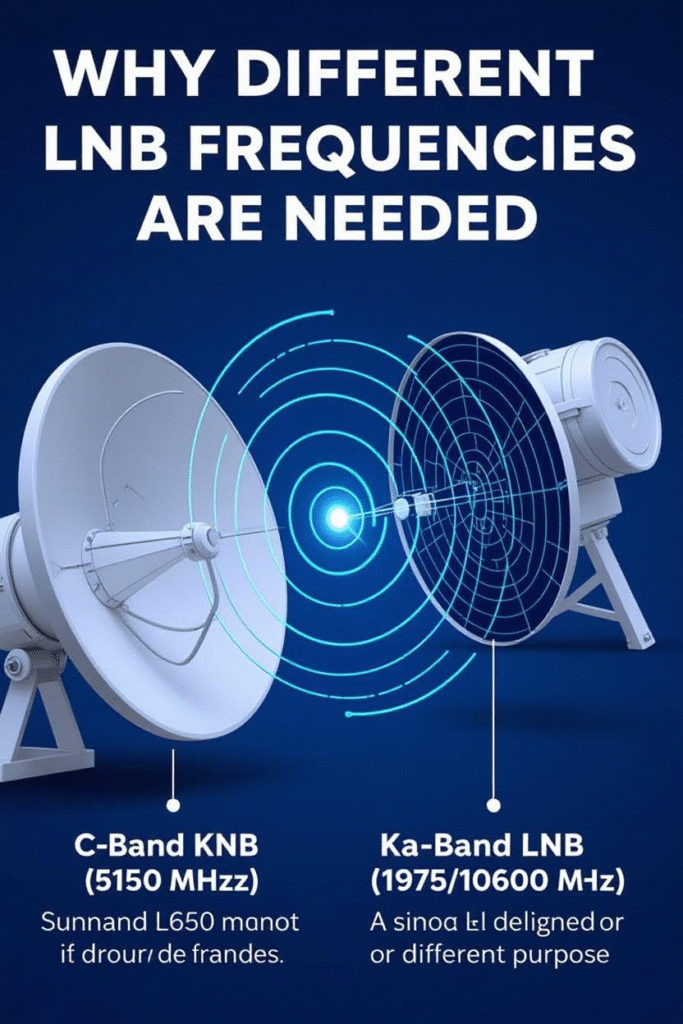
Why Different LNB Frequencies Are Needed
Imagine tuning a radio. If your radio only supports FM frequencies, you cannot hear AM stations. The same principle applies to satellite TV:
- A C-band LNB frequency (5150 MHz) cannot decode Ku-band signals.
- A Ku-band LNB (9750/10600 MHz) cannot capture C-band channels.
- A Ka-band LNB is designed for a completely different purpose.
That is why choosing the correct LNB frequency and LNB type is crucial for receiving the channels you want.
The Role of Dish Size in LNB Frequency
LNB frequency is not the only factor; dish size also matters:
- C-Band: Requires a big dish (6–12 ft) because signals are weaker but more stable against rain.
- Ku-Band: Works with smaller dishes (60–120 cm) but suffers from rain fade.
- Ka-Band: Uses small dishes but requires precise alignment.
This is why in Pakistan, India, and Africa, C-band is still very popular in villages, while cities mostly use Ku-band DTH dishes.
How to Check and Set LNB Frequency in Receivers
Every satellite receiver allows you to manually set the LNB-frequency.
- Go to Installation → LNB Setup → LNB Frequency.
- Select the correct value: 5150 MHz (C-band), 9750/10600 MHz (Ku-band), or Ka-band if applicable.
- Wrong settings = No Signal.
For example:
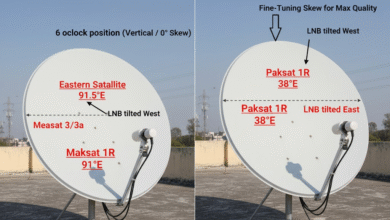
- If you are pointing your dish to Paksat at 38°E using a C-band dish, you must select LNB frequency 5150 MHz.
- If you are using a small dish for Asiasat or Hotbird, choose 9750/10600 MHz.
The Future of LNB Frequency and Satellite TV
With the rise of IPTV and streaming services, many believe satellite TV is fading. But in reality, satellite TV still serves millions of homes because it provides free-to-air and subscription channels without requiring high-speed internet.
- New satellites are being launched in Ku-band and Ka-band to provide both TV and internet services.
- Multi-feed LNBs and Monoblock LNBs are getting popular because viewers want access to multiple satellites.
- The role of LNB frequency will remain essential as it ensures compatibility between the dish, the satellite, and the receiver.
Conclusion
The world of satellite TV revolves around one small but powerful detail: the LNB frequency. Whether you use a giant C-band dish in rural areas, a small Ku-band dish for DTH services, or a Ka-band setup for satellite internet, the right frequency ensures that your TV receives clear, uninterrupted signals.
Understanding how LNB frequencies work and knowing which type of LNB to use can save you time, money, and frustration. So the next time you set up your dish or buy a new receiver, remember that everything begins with the LNB frequency.